How ES Energy Save, together with our Chilean partner Scanditec, is powering a new generation of energy-efficient homes in Chile
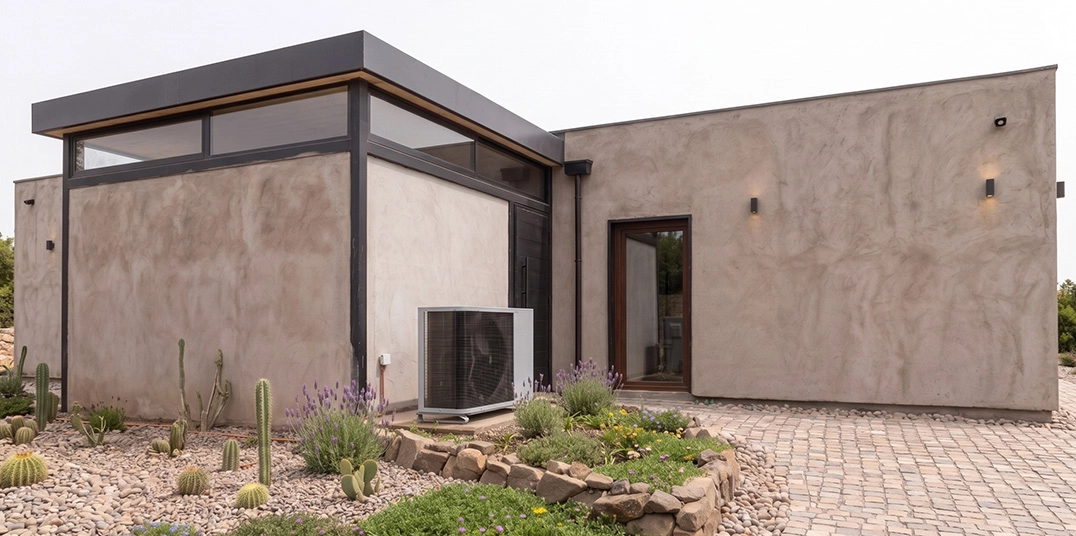
At ES Energy Save, we have always believed that the same technology developed for Sweden’s demanding climate can bring real value anywhere in the world where people want reliable comfort with low energy consumption. Casa Chucao, the first demonstration home built by Blum Wellness Homes in Chile, is one of the clearest examples of that belief in practice. We are proud that our technology was installed and commissioned by our partner in Chile, and today that collaboration continues through Scanditec, the Chilean subsidiary our distributor JCE South America established last year to represent ES Energy Save locally.
A Market Without a Real Heating Standard
In Chile, homes are often sold without any heating system installed at all. Where heating is included, gas is typically the default choice, an expensive and inefficient solution that leaves homeowners exposed to fluctuating energy costs and uneven comfort. Rodrigo Blum, founder of Blum Wellness Homes and a civil engineer with more than 20 years of experience, describes this gap as a hidden “hipoteca energética,” or energy mortgage, that homeowners unknowingly sign up for every time they buy a conventional home.
A Chance to Prove the Model
ES Energy Save has worked with partners in Chile for several years to bring Scandinavian heat pump technology to the market. Around the time Casa Chucao was being planned, Rodrigo Blum had decided to stop describing his vision for energy-efficient housing and start proving it, with a real, occupied home and verified, measurable results, an opportunity that lined up naturally with our growing presence in the country.
A Model Built to Scale
Blum Wellness Homes wanted more than one efficient house. The ambition was a proof point for a scalable business model: stable, healthy indoor comfort 24 hours a day, throughout every season, with a running cost low enough to change the economics of homeownership, backed by real operating data rather than promises. That data was essential to convince investors, architects and future buyers that the model works.
Matching the Technology to the Passive House Standard
Casa Chucao was built to the Passive House standard, a benchmark still held by fewer than 1% of homes in Chile. A high-performance building envelope like this calls for steady, low-flow-temperature operation that keeps the indoor climate stable without waste, exactly what a well-designed heat pump delivers. It was also the only realistic way to combine heating, cooling and domestic hot water into a single, space-efficient system.
Reliability, Complete Systems and Local Support
Energy Save’s roots are in Sweden, in a climate that leaves no room for compromise on reliability during harsh winters, and that same engineering now flexibly provides heating, cooling and hot water from a single unit, adaptable to Chile’s varied climates. Last year, our collaboration in Chile took a more formal shape when our distributor JCE South America established Scanditec, a dedicated subsidiary, to represent ES Energy Save locally. Scanditec’s presence on the ground mattered just as much: our digital platform, which allows remote monitoring, software updates and troubleshooting, is a decisive advantage in a country where long distances make on-site service costly and time-consuming. Together, this gave Blum Wellness Homes a secure, complete system solution, from installation to ongoing support.
The System
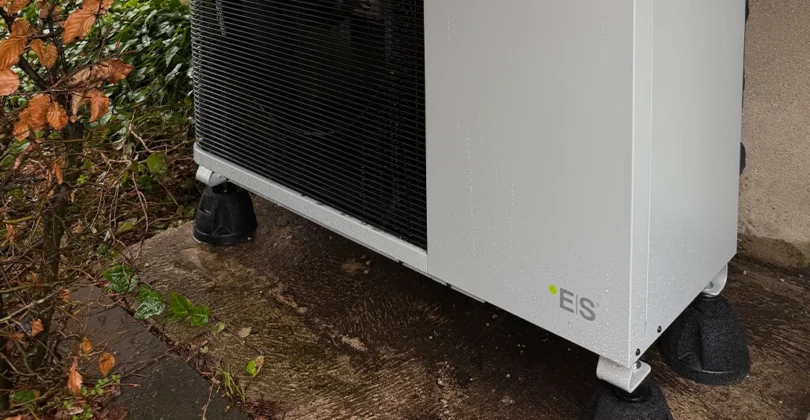
Our partner in Chile designed, supplied, installed and commissioned a solution built around our Energy Save AW12-R32-M V8, a 12 kW air-to-water heat pump delivering heating in winter, cooling in summer, and domestic hot water year-round. Heating and cooling are distributed through three ducted fan coils with indoor unit control, supported by a 100-liter buffer tank, an approximately 250-liter domestic hot water tank, and remote monitoring of temperatures, energy consumption and operating conditions.
The system runs on continuous, low-flow-temperature operation rather than short bursts of intense heating or cooling, the same logic that underpins efficient heat pump performance in Swedish winters, now applied to a Chilean passive house.
Two Years of Real-World Results
Casa Chucao has now been in operation for approximately two years, giving both Blum Wellness Homes and us real operational data rather than simulations. Based on the company’s own published figures, comparing recorded electricity consumption against a conventional home, Casa Chucao has achieved approximately 64% energy savings. For us, this real-world verification is exactly what matters most: it’s one thing to design a heat pump for efficiency in a lab, another to see it deliver measurable, multi-year savings in an occupied home.
A Reference Project
Casa Chucao, also referred to by our partner as Casa Pasiva N°1, has set something bigger in motion. Scanditec has established a collaboration with the architect behind the project, under which his upcoming passive house developments will be designed from the outset around Energy Save’s heat pumps and complete system solutions for heating, cooling and domestic hot water. It is the first reference project in what is intended to be a long-term collaboration on future passive houses in Chile, with Energy Save’s technology designed from the planning stage rather than specified after the fact.
Looking Ahead
Blum Wellness Homes is already developing a second demonstration home in the Colina–Chicureo area, with ambitions to scale its passive-house licensing model across multiple regions in Chile and, further ahead, into other Latin American markets facing similar energy-cost pressures, including Colombia, Mexico and Argentina.
For Energy Save, Casa Chucao is a proof of concept for how our technology, delivered through strong local partnerships like the one we have built with Scanditec, can support the next generation of energy-efficient housing across Latin America.