A Hungarian office building replaced a failing central chiller with a scalable cascade of ES Energy Save heat pumps, installed by our partner ES Hőszivattyú, gaining reliability today and room to grow tomorrow.
When the 400 kW central chiller serving a multi-tenant office building in Budapest, Hungary, began to fail, the facility management team faced more than a simple repair job. The building had been running on an outdated setup: a single 240 kW chiller for cooling, four buffer tanks, and, during the winter heating season, pure electric resistance heating elements to produce hot water.
The Previous Situation
The old system had two structural weaknesses that had bothered the facility team for years. First, it relied on a single point of failure: if the chiller went down, cooling for the entire building stopped immediately, with no backup capacity to fall back on. Second, the winter heating setup was expensive to run. Electric resistance heating has a coefficient of performance (COP) of around 1, meaning every unit of electricity produced only one unit of heat, a costly and inefficient way to heat a commercial building through a Central European winter.
The Trigger
The failing chiller forced the issue. With the unit nearing the end of its service life and no redundancy in place, the owners and facility management team could no longer postpone a decision. A breakdown was not a question of if, but when; and the building could not afford unplanned downtime affecting tenant comfort.
What the Customer Wanted to Achieve
Rather than simply installing a new chiller of the same type and size, the customer used the moment to set a broader goal: a flexible, low-maintenance heating and cooling system that could keep pace with the building’s changing needs. Three priorities stood out: eliminate the single point of failure, cut the high cost of electric winter heating, and build a system that could scale as occupancy in the building increased, without requiring another major overhaul down the line.
Why a Heat Pump Cascade
A single large chiller, sized for the building’s ultimate capacity, would have meant poor part-load efficiency and short-cycling during the many hours when demand is lower than peak. An undersized unit, on the other hand, would leave no room for future tenants. A cascade of smaller heat pump modules solved both problems at once.
With a cascade setup, only as many units run as the current load requires, each modulating precisely thanks to inverter-driven compressors. Run hours are distributed evenly across the units by the cascade controller, spreading wear and extending service life. And critically, if one module needs maintenance, the others continue covering the building’s baseline heating and cooling load — cooling and heating no longer depend on a single machine staying online.
Why ES Energy Save
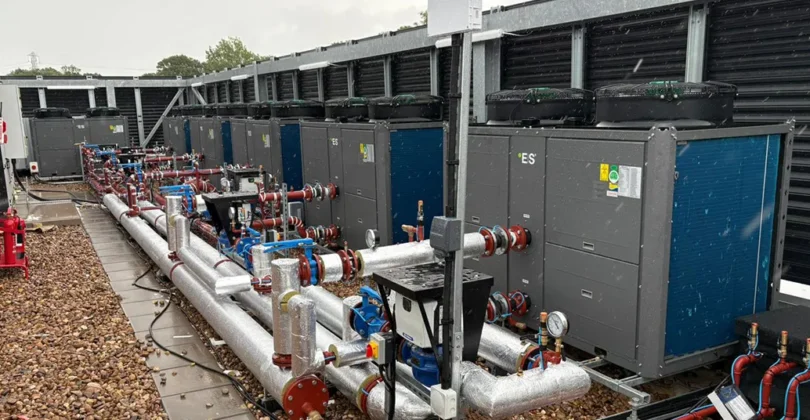
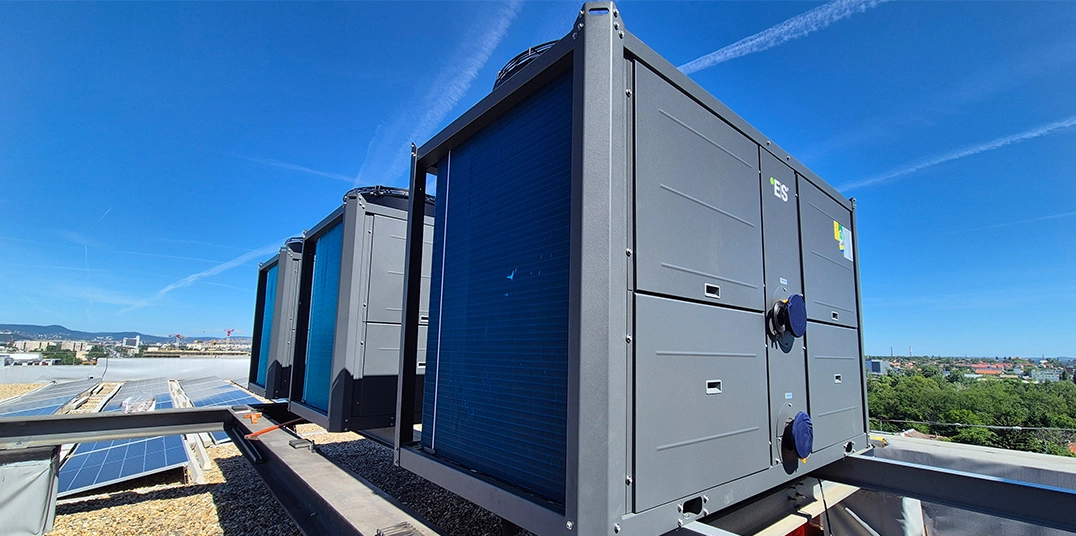
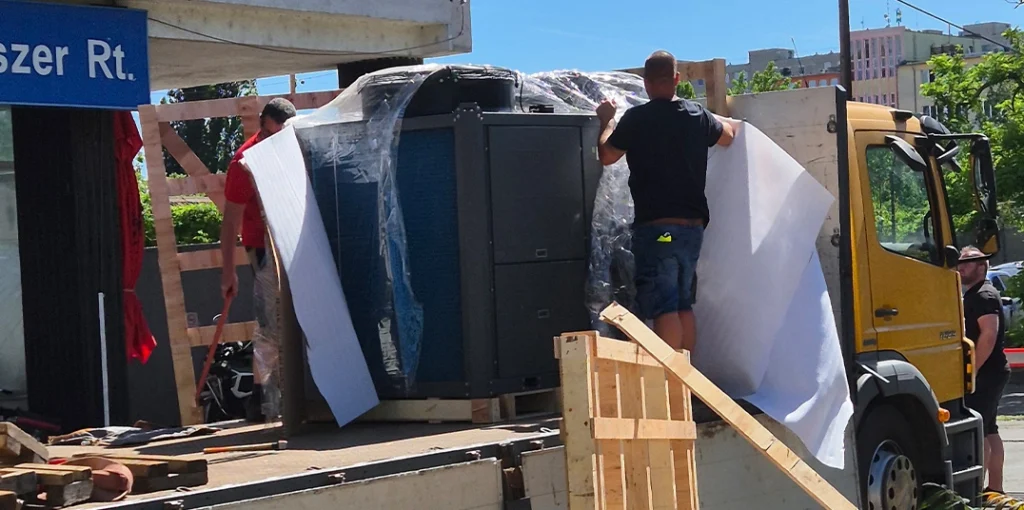
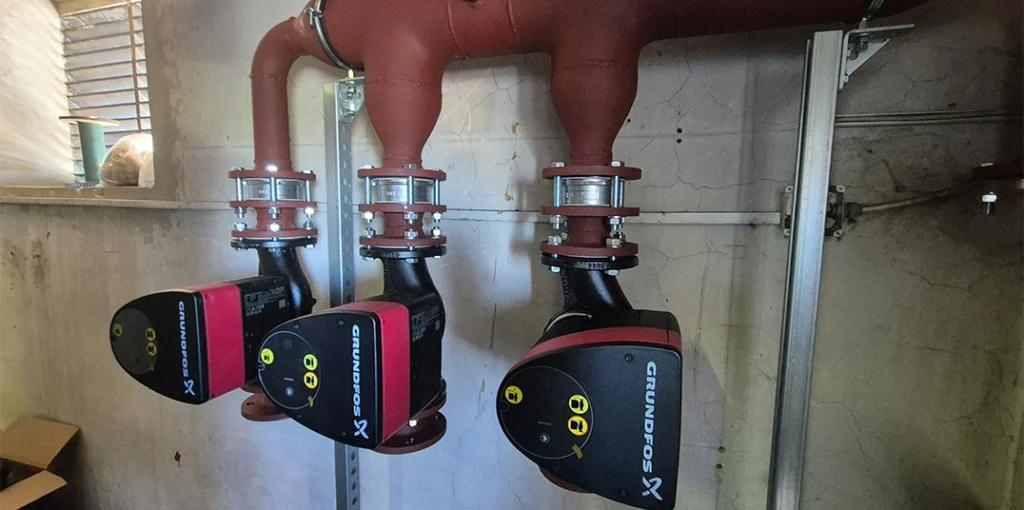
The building’s existing hydraulic circuit, including its four buffer tanks, could be reused, which made a modular retrofit both practical and cost-effective. Three ES R410A Commercial Series heat pumps, rated at 90 kW each, were installed in place of the old chiller and connected into the existing system with minimal structural change.
The decisive factors for the customer were the modularity of the ES commercial range, the software-ready cascade control that made scaling straightforward, and the ability to reuse the existing hydraulic infrastructure, keeping installation time and disruption to tenants to a minimum.
“The reliability and flexibility of the ES system gave us exactly what we needed — no more single point of failure, and room to grow as new tenants move in.”
Built to Grow With the Building
At installation, the building was around 60% occupied, giving a combined capacity of 270 kW across the three units. This comfortably covers current peak cooling demand. The system was designed to expand alongside the building:
60% occupancy (today): 3 × 90 kW = 270 kW
80% occupancy: +1 module → 4 × 90 kW = 360 kW
100% occupancy: +2 modules → 5 × 90 kW = 450 kW
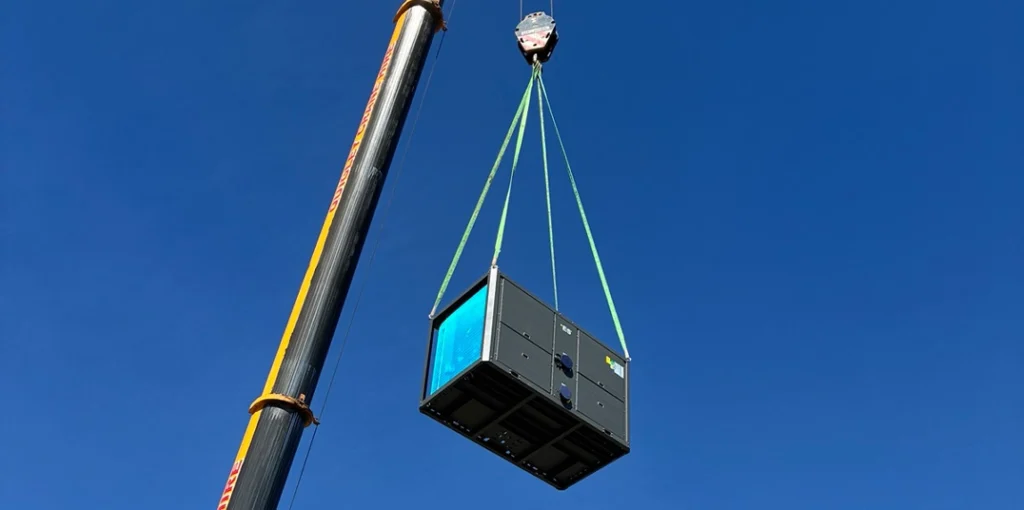
As new tenants move in, additional 90 kW modules can be added to the same cascade with minimal downtime and no structural rework, turning what used to be a major future investment decision into a simple, step-by-step process.
The Result
The three heat pumps now handle both heating and cooling for the building. In summer, the combined 270 kW capacity meets peak cooling demand comfortably, with the four buffer tanks acting as a hydraulic buffer between the heat pumps and the building’s fan-coil network. In winter, phasing out the electric heating elements in favor of ambient-air heat pump heating has significantly improved the heating COP, cutting energy costs for hot water production.
For the facility management team, the result is a reliable, low-maintenance system that removes the single point of failure, lowers running costs, and is ready to expand as the building fills up — all while supporting the building’s ESG targets.